

The Pentagon is not buying a satellite-removal capability. It is testing whether one can be bought as a service. The Defense Innovation Unit and the Space Development Agency have selected D-Orbit USA, Firefly Aerospace, and Katalyst Space for preliminary design and risk-reduction work on deorbit-as-a-service.
No provider has been selected for an on-orbit demonstration, and no company has shown that it can routinely rendezvous with, capture, and dispose of an unprepared satellite at an acceptable cost and risk. What is happening now is an acquisition experiment: the government is checking whether it can buy the outcome—safe disposal—without owning a disposal spacecraft.
Deorbit-as-a-service is a study, not an operational capability
The agencies’ stated objective is a scalable commercial capability to rendezvous with, capture, and deorbit unprepared or non-cooperative satellites. The three companies begin with preliminary design and risk-reduction activities. DIU and SDA will then compare technical maturity, mission approach, schedule, and affordability before deciding whether to fund a full on-orbit demonstration.
That sequence is deliberate. The government is not treating a vendor proposal or a spacecraft rendering as evidence that the mission can be performed. It is competing the difficult parts of the problem before committing to a flight test.
The program is also not a replacement for existing disposal planning. Space Development Agency satellites are designed with end-of-life requirements. A commercial service would add an option for aging, failed, or otherwise unprepared spacecraft—including missions whose original disposal plan no longer works.
The mission is a chain of hard problems
“Deorbiting a satellite” sounds like one maneuver. It is a sequence of tightly coupled operations, and each one can end the mission:
- Reach the target orbit with enough remaining propulsion to finish the job.
- Locate and characterize a spacecraft whose attitude, status, and trajectory may be uncertain.
- Conduct autonomous rendezvous and proximity operations without colliding with the target.
- Capture a vehicle that may have no cooperative docking interface.
- Control the combined stack after capture.
- Supply enough propulsion to place the target on a safe disposal trajectory without creating new debris.
Mission risk is therefore not well represented by the servicer’s launch success or by the target satellite’s mass. It accumulates across the chain.
Three companies, three different bets
Firefly Aerospace proposes to use its Elytra orbital vehicle for rendezvous, inspection, proximity operations, and disposal maneuvers. The architecture is attractive because Elytra is intended as a broader orbital-services platform rather than a single-purpose tug. The risk is maturity: Elytra had not flown its first mission as of the SpaceNews report, and the public description says less about how it would physically capture a genuinely non-cooperative target.
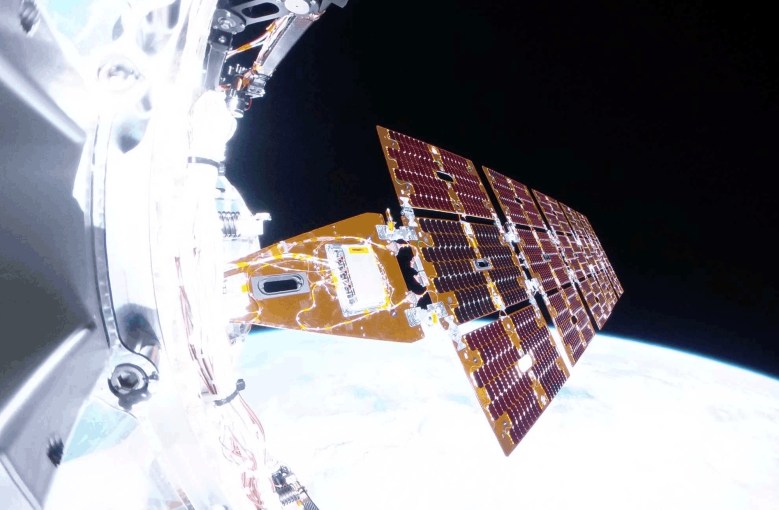
Katalyst Space is pursuing a more explicit robotic-servicing approach. Its Link vehicle launched on NASA’s Swift Boost mission and is intended to rendezvous with and service the Neil Gehrels Swift Observatory using robotic arms. That is directly relevant experience, and it is still a high-risk demonstration. A spacecraft prepared for a servicing mission is not equivalent to an unknown, tumbling, or structurally fragile derelict.
D-Orbit USA is approaching the problem through a space-logistics architecture, reportedly combining a servicer with external capture and autonomy technologies. That could provide flexibility across target types, but every added subsystem carries an integration and qualification burden. The government will need evidence that the combined system is safer than a simpler alternative, not just more capable on paper.
Why the acquisition model matters
A government-owned disposal spacecraft would keep design authority, mission assurance, and long-term availability inside one program. A service model splits those responsibilities between the government and its providers.
The service model offers three things a program of record does not:
- Lower standing cost: the government pays for missions or availability instead of maintaining a dedicated fleet indefinitely.
- Competition: multiple providers can develop different capture and propulsion approaches.
- Scalability: a working service can support more than one satellite family or government customer.
It also creates new dependencies. The government has to define target conditions, safety standards, data rights, response timelines, and liability boundaries before it can compare bids meaningfully. “Dispose of an unprepared satellite” is an outcome. It is not yet a contract requirement.
Safety is the real product
The value of a disposal service is not whether a target reaches a lower orbit. It is whether the operation lowers the probability of future collisions without creating a new debris field.
That requires rules for approach, capture, failure recovery, and post-capture control. A servicer that loses attitude control near a dead satellite becomes a second dead satellite. A capture mechanism that damages the target turns a manageable disposal problem into a fragmentation event.
NASA’s orbital-debris guidance emphasizes prevention, tracking, and responsible end-of-life operations. A defense procurement has to add a layer to that: the service must be safe enough to operate around spacecraft whose ownership, mission status, and maneuverability may all be uncertain.
This is why Katalyst’s servicing demonstration matters even if the company is not selected. The government needs flight evidence for autonomous navigation, proximity operations, capture, and control.
The strategic question is whether disposal becomes infrastructure
The United States is moving toward large constellations in which failure, obsolescence, and partial loss of control are normal lifecycle conditions. A disposal service could become part of what makes those constellations sustainable.
That does not mean an external servicer should remove every dead satellite. Most spacecraft can and should dispose of themselves. Commercial servicing is most valuable where the original plan fails, the spacecraft was never designed for capture, or the government needs a contingency option in a strategically important orbit.
Over time, the service could also shape spacecraft design. If operators know a future servicer can safely capture a standard grappling fixture, they may accept lower self-disposal margins or adopt common interfaces. That would be a useful outcome, and it would require standards rather than individual missions.
The STC read: procurement is the demonstration
DIU and SDA have not selected a deorbiting provider. They have selected three competing answers to a hard acquisition question: can the government buy safe disposal of unprepared satellites as a recurring commercial service?
The answer depends on evidence. A winning system has to find the target, approach it, capture it without creating debris, control the combined vehicle, and complete disposal at a price and schedule the government can use. It also has to define what happens when the target is tumbling, the servicer loses a sensor, or the first disposal attempt fails.
That is what makes this program worth watching now. The United States is not funding another servicing demonstration. It is testing whether orbital cleanup can move from an exceptional government mission to an accountable piece of commercial space infrastructure.
Sources
[1] Sandra Erwin, “U.S. defense agencies tap three companies for satellite disposal study,” SpaceNews, August 2026. Report.
[2] Defense Innovation Unit and Space Development Agency, program announcement and company posts. Official DIU posts.
[3] NASA Orbital Debris Program Office, “Mitigation.” Official guidance.
[4] Katalyst Space, company information on robotic servicing and Link. Official site.
[5] Firefly Aerospace, Elytra and orbital-services information, as reported in the cited SpaceNews coverage. Company site.
