NASA’s October 7 release preserves the observations behind the photographs, along with the limits researchers will need to understand.
NASA has released the lunar science archive from Artemis II, giving researchers access to the photographs, spoken observations and annotated views collected during the crew’s April lunar flyby. Announced October 7, the release contains more than 800 gigabytes of material, including more than 11,000 full-resolution images, video and 8.5 hours of scientific audio. NASA also published a preliminary science report, an operations report and a data user guide. The new development is public access to that record; Orion’s closest approach to the Moon occurred April 6. [1][2]
The reports show why a crewed science archive needs more than an image catalog. An astronaut can notice a fleeting flash or a change in apparent color, describe it, photograph the surrounding terrain and mark its location. Reusing that observation requires knowing how those records fit together.
Reconstructing What the Crew Saw
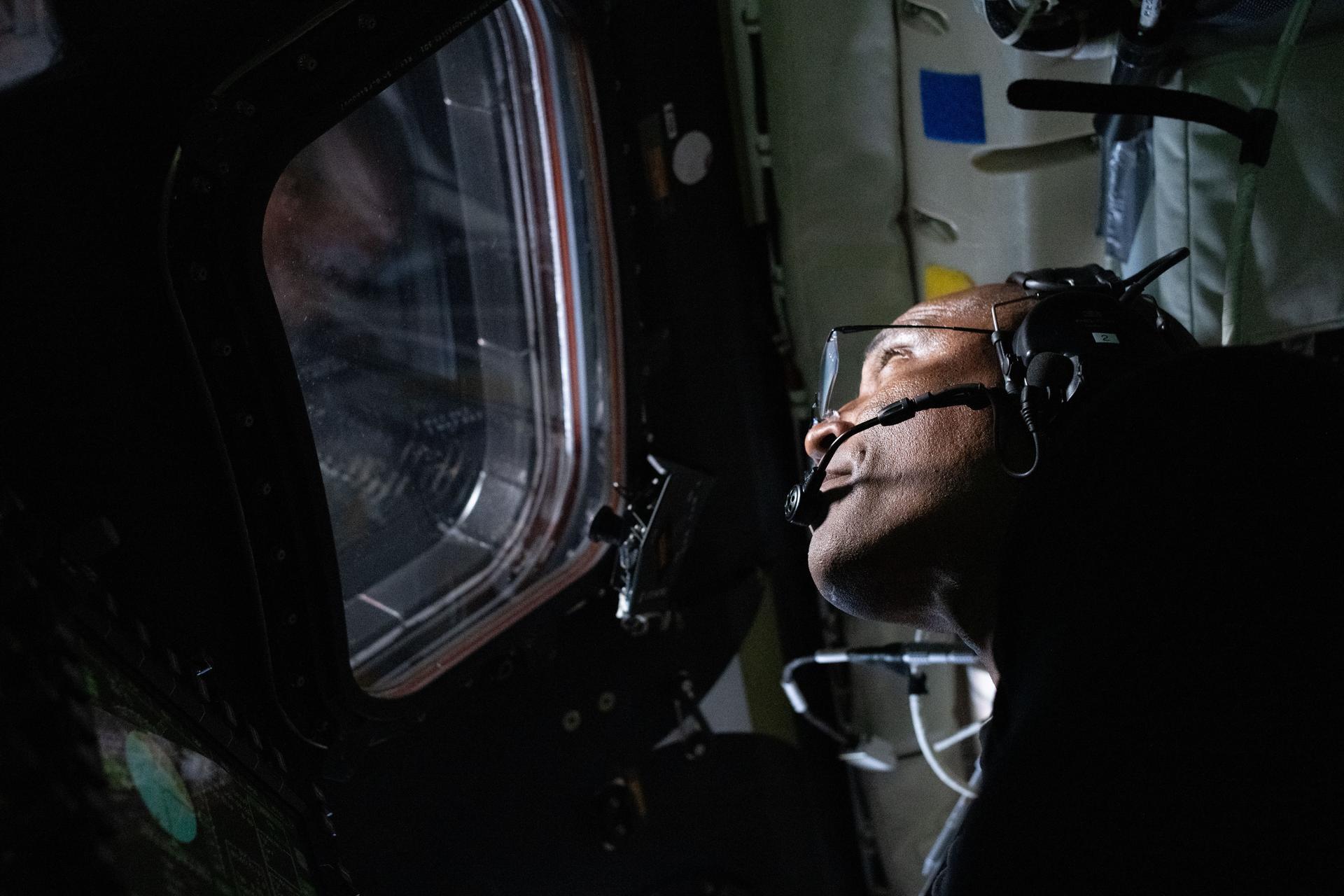
During the flyby, the four astronauts worked in two teams, taking turns at the windows. One astronaut in the observing team operated a camera while the other observed directly, and both recorded their descriptions. The other team monitored Orion and supported the observers. Afterward, the astronauts clarified annotations and added notes as they prepared the files for downlink. Audio received the highest downlink priority because scientists needed the crew’s observations for the following day’s discussion while the experience was fresh. [3]

The archive preserves that context through transcripts and accompanying metadata. Automated transcripts were checked and corrected by the science team, which also identified speakers. Timing required particular care: the tablet audio files recorded when a recording ended, so the archive’s labels supply reconstructed start times. For a subset of lunar photographs, image matching connects recognizable surface features with reference-map coordinates. That allows researchers to investigate where an image belongs on the Moon, rather than relying only on its caption. [4]
The preliminary report adds a practical warning: astronauts sometimes described locations using clock directions while facing different ways at the window. A feature at “seven o’clock” therefore needs the accompanying image for interpretation. [5]
Five Flashes, With Important Boundaries
The clearest example is the crew’s report of five distinct impact flashes during the solar eclipse seen from Orion. Several were observed simultaneously by more than one astronaut. The crew documented the sightings in audio and marked approximate locations on an annotated visualization, excluding flashes they considered ambiguous. NASA’s science team treats these as impact detections. [5]
The supporting evidence has limits. No flashes were detected in the roughly two-minute, 30-frame-per-second exterior-camera recording examined by NASA’s Meteoroid Environment Office. That short sample does not establish that the crew’s sightings were wrong. The report also says the crew’s position estimates are insufficient to target follow-up observations with the Lunar Reconnaissance Orbiter, and the expected craters would probably be too small for its camera to resolve. [5]
Color observations need similar care. The science report treats the crew’s descriptions as the primary record for that topic because the mission’s images lacked the calibration needed for quantitative color analysis. Photographs supply context; they do not by themselves establish a measured mineral composition. [5]
What Future Missions Need to Preserve
There are remaining archive gaps. The Planetary Data System calls this the first delivery and lists the SPICE bundle, which supplies observation geometry and supporting information, as delayed. The user guide assigns no products to the Planetary Data System’s calibrated or derived categories; raw and partially processed products are included. Researchers have access to observations and documentation, with further processing still required for some analyses. [2][4]
The reports turn those limitations into concrete recommendations: dedicated impact-flash instrumentation, better camera calibration and coordinated timestamps across science devices. They also recommend continuous onboard audio recording to reduce the crew’s manual recording workload. For future mission designers, those choices determine whether an observation can be connected reliably to an image, a location and a moment in time. The outstanding geometry bundle is one concrete item to watch; the broader scientific test is what researchers can establish from the combined record. [2][5]
Sources
- NASA, “NASA Releases Artemis II Lunar Science Data, Images,” October 7, 2026.
- NASA Planetary Data System Geosciences Node, “Artemis II Mission,” first-delivery notice dated October 7, 2026.
- Artemis II Lunar Science Operations Report, sections 6.2.6–6.2.8, 6.4.4 and 7.5.
- Artemis II Lunar Science Data User Guide, version 1.0, October 7, 2026, sections 5, 5.2.7 and 5.4.
- Artemis II Preliminary Lunar Science Report, sections 5, 5.1.2, 5.2 and 9.6–9.9.