
Published: February 15, 2026
The space industry experienced a significant strategic shift this February. In the span of two weeks, the United States and China — the two leading spacefaring nations — openly acknowledged that the Moon, not Mars, represents the near-term focus for human expansion into space. This lunar realignment reflects changing economic priorities and technological realities that are reshaping the next phase of space exploration.
The shift became clear on February 9, when Elon Musk announced SpaceX had “shifted focus” from Mars to building a “self-growing city on the Moon,” delaying Mars colonization by “about five to seven years.” [1] Two days later, China successfully tested the abort system of its Mengzhou spacecraft, demonstrating critical safety systems for their crewed lunar program. [2] The timing suggests the U.S. and China are responding to similar market pressures and competitive dynamics in the emerging lunar economy.
The Lunar Business Case
SpaceX’s Mars delay represents an economic awakening rather than a technical setback. Musk framed the pivot in civilizational terms — “the overriding priority is securing the future of civilization and the Moon is faster” — but the company also told investors it would prioritize lunar missions, suggesting financial calculations played a role. [10] Artemis contracts, commercial lunar stations, and eventual resource extraction rights present a more accessible business model than the long-term Mars vision.
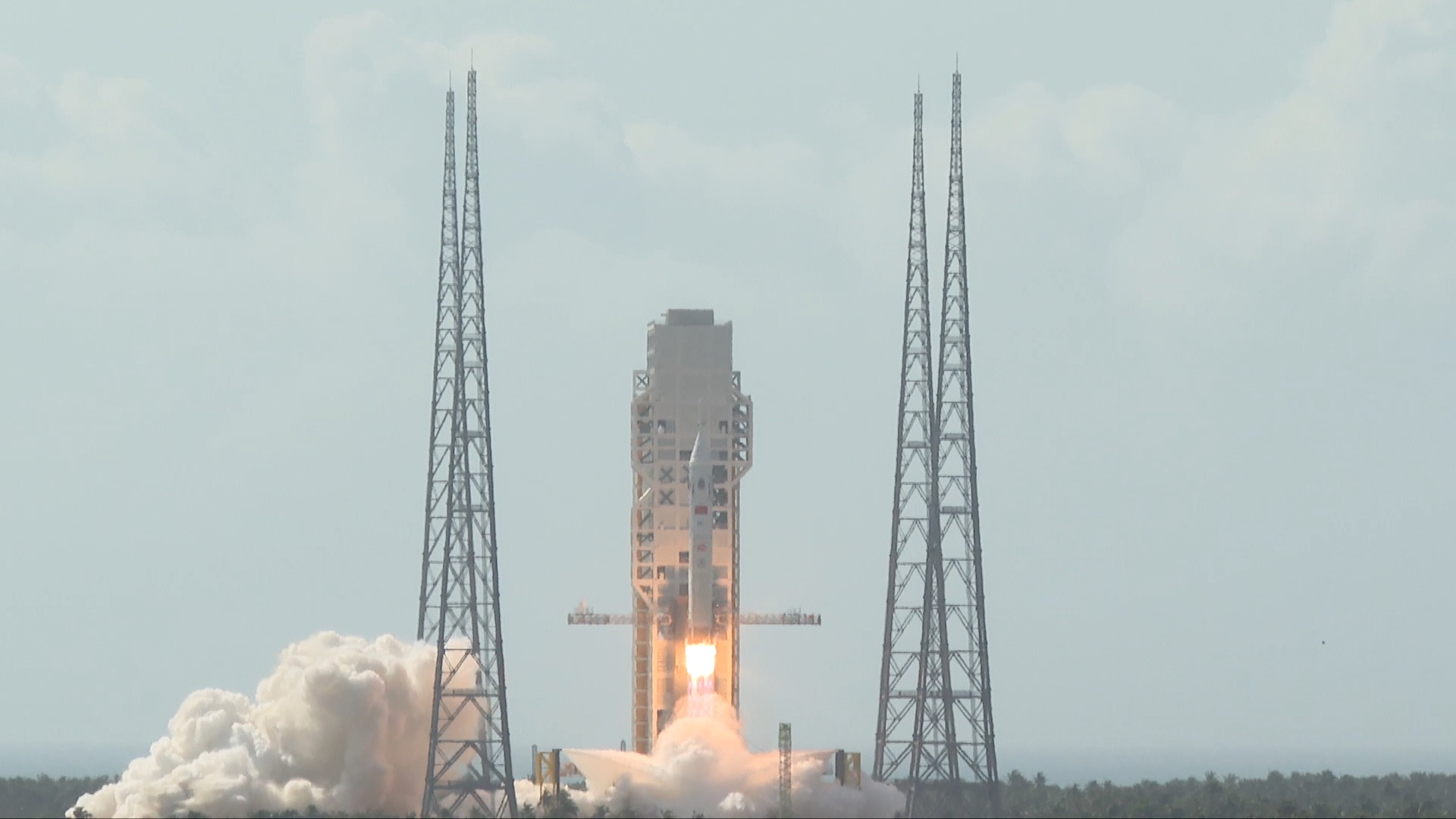
[Image: China’s Mengzhou spacecraft during abort system test. Credit: CNSA]
This strategic pivot aligns with NASA’s lunar surface operations timeline and reflects broader industry calculations. The Moon offers many of the same benefits as Mars — technological advancement, scientific discovery, human expansion — but with supply lines measured in days rather than months, and rescue missions measured in hours rather than years. For a company that has proven adept at turning government contracts into profitable ventures, the lunar economy represents a more realistic near-term opportunity.
The delay also demonstrates how market forces are influencing space exploration priorities. Private companies must balance visionary goals with financial sustainability, and lunar missions currently offer better return-on-investment prospects than Mars colonization.
China’s Methodical Progress
While American space policy navigates political cycles and budget debates, China has been systematically advancing their lunar program. The February 11 success of the Mengzhou spacecraft abort system represents another critical milestone in their independent crewed space capability.
The test validated both the launch escape system and demonstrated the Long March 10A rocket’s first stage soft landing capability on water. More importantly, it proved that China’s crew-rated lunar vehicle functions properly under emergency conditions — exactly the kind of essential capability that determines mission success or failure.
China’s approach lacks the theatrical elements of American space programs, but compensates with consistent progress and political stability. Their methodical advancement toward human lunar missions by 2030 contrasts with American programs that remain subject to congressional budget battles and changing administrations.
Launch Market Diversification
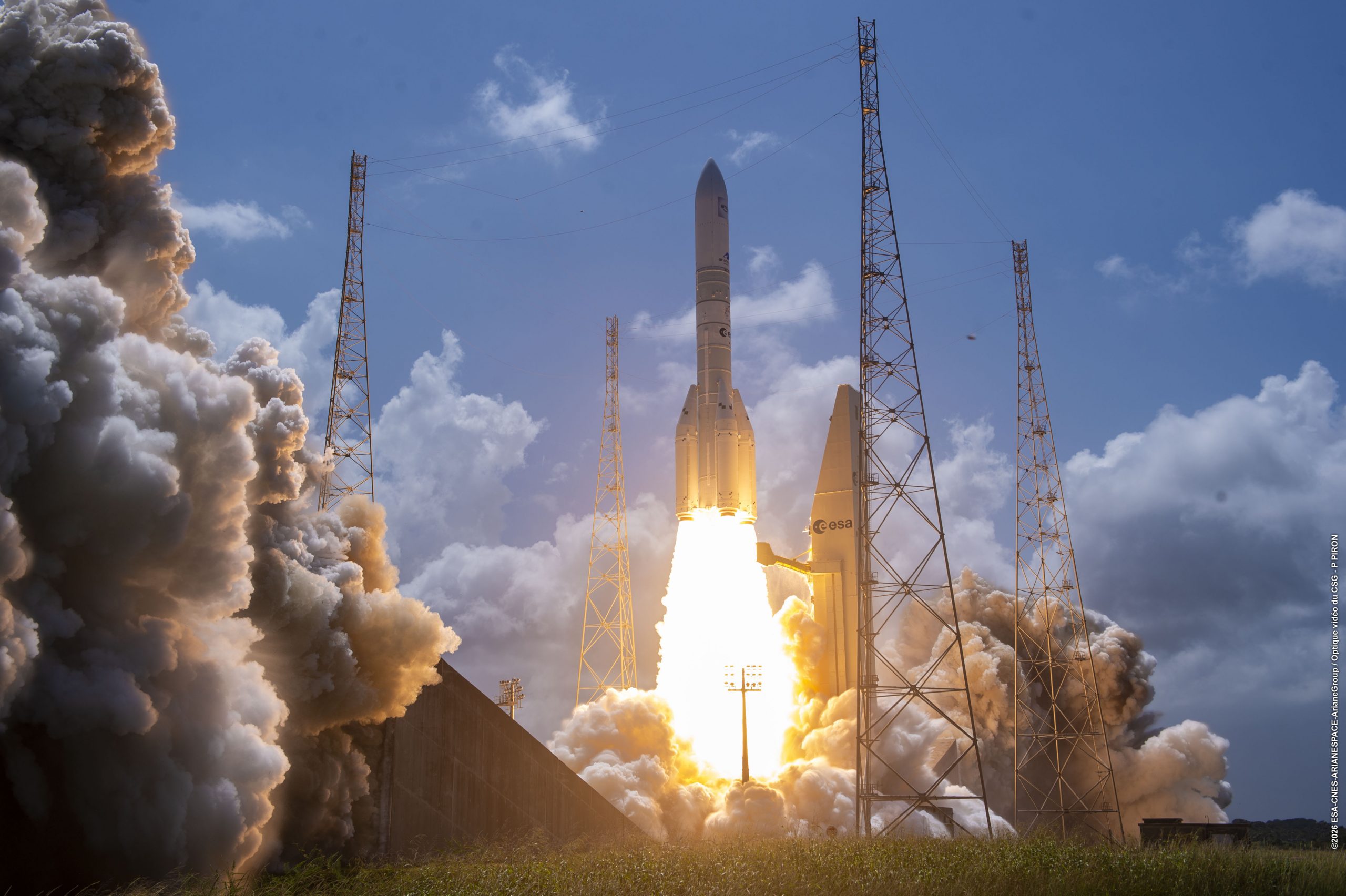
The lunar realignment coincided with significant developments in the launch industry. February 12 delivered two successful missions that demonstrated the maturation of the market beyond single-vendor dependence: Europe’s successful maiden flight of the Ariane 64 carrying Amazon satellites [3], followed by ULA’s flawless Vulcan mission with the USSF-87 national security payload. [4]
These launches represent healthy market diversification. Europe demonstrated renewed heavy-lift capability precisely when lunar missions will require it, while ULA maintained its role in national security launches. The successful Ariane 64 debut is particularly significant because the four-booster configuration provides the payload capacity that lunar infrastructure missions will demand.
[Image: Ariane 64 lifting off from Kourou with four solid boosters. Credit: ESA/CNES/Arianespace]
This market evolution creates strategic resilience. Rather than depending on a single provider, space operations can now draw from multiple launch capabilities, each optimized for different mission requirements. This diversification strengthens the entire space economy’s ability to support sustained lunar operations.
The Routine Revolution
Perhaps the most important development this February was how routine space operations have become. NASA’s Crew-12 mission launched and docked with the International Space Station with minimal fanfare — Jessica Meir, Jack Hathaway, Sophie Adenot, and Andrey Fedyaev arrived at the station on Valentine’s Day to begin an eight-month research mission.
The most remarkable aspect of their journey was how unremarkable it felt. NASA has successfully normalized human spaceflight operations through commercial partnerships, creating the operational foundation that enables more ambitious lunar goals. Every routine crew rotation represents capacity freed up for Artemis planning and execution.
Even SpaceX’s Valentine’s Day Starlink launch, which created a spectacular light show across Southern California, barely registered as news beyond the visual display. Twenty-four more satellites joined a constellation approaching operational completion, deployed by systems that have become reliably predictable. This infrastructure backdrop provides the communications and navigation capabilities that lunar operations will require.
JWST’s Scientific Acceleration
While strategic and economic forces reshape human spaceflight, the James Webb Space Telescope delivered two significant discoveries that demonstrate its operational maturity. On February 9, the telescope detected methane for the first time in an interstellar object — comet 3I/ATLAS, originating from outside our solar system. Two days later, JWST revealed an unprecedented mix of organic molecules in an ultra-luminous infrared galaxy, including benzene, methane, and the highly reactive methyl radical.
These discoveries represent JWST operating at peak scientific efficiency. The telescope has transitioned from an engineering achievement into a systematic discovery platform. For space exploration, this means robotic scouts are mapping the chemical landscape that human missions will eventually encounter.
The timing aligns well with the lunar realignment. As human spaceflight establishes sustainable lunar operations, space-based observatories continue expanding our understanding of targets for future exploration. JWST’s organic compound discoveries provide crucial context for the life-detection missions that may follow.
Strategic Assessment
The lunar realignment reflects more than changed destination preferences — it represents a fundamental reorganization around achievable economics and realistic timelines. SpaceX’s Mars delay acknowledges that lunar infrastructure development is prerequisite to sustainable deep space operations. China’s methodical lunar progress demonstrates advantages of policy consistency over democratic volatility. Launch market diversification ensures that no single entity can monopolize space access.
Most significantly, this alignment creates competitive dynamics that may accelerate progress. When major space powers focus on the same destination with clear economic incentives and achievable timelines, development pace typically increases.
The Moon offers practical advantages for developing space-based capabilities: manufacturing facilities, fuel production, and deep space launching platforms are all more feasible to establish and maintain in lunar gravity with Earth support than in Mars isolation. These capabilities become stepping stones rather than end destinations.
Looking Ahead: Late February 2026
The lunar realignment will likely continue developing through the rest of February. Watch for:
- Artemis Program updates — NASA’s lunar mission timeline may shift in response to China’s accelerating progress, with potential adjustments to development schedules and funding requests.
- Commercial lunar announcements — With SpaceX openly prioritizing lunar missions, other commercial space companies could follow with Moon-focused initiatives.
- International partnership dynamics — European and Japanese space agencies face growing pressure to clarify their roles as U.S.-China lunar competition intensifies.
- Launch market pricing — February’s successful Ariane 64 and Vulcan missions could trigger competitive responses from other providers.
The broader trend points toward space competition driven by economics rather than pure national prestige — a race to establish the first sustainable lunar economy.
Sources
[1] TIME, “Elon Musk Postpones Mars Plans in Favor of Building ‘Moon City,'” February 9, 2026. https://time.com/7373155/elon-musk-mars-moon-city/
[2] SpaceNews, “China tests crewed spacecraft abort and rocket recovery in major lunar milestone,” February 11, 2026. https://spacenews.com/china-tests-crewed-spacecraft-abort-and-rocket-recovery-in-major-lunar-milestone/
[3] Reuters, “Europe’s Ariane 64 heavy launcher puts Amazon satellites in orbit,” February 12, 2026. https://www.reuters.com/science/europes-ariane-64-heavy-launcher-puts-amazon-satellites-orbit-2026-02-12/
[4] NASASpaceflight.com, “USSF-87 Launch,” February 12, 2026. https://www.nasaspaceflight.com/2026/02/ussf-87-launch/
[5] https://www.nasa.gov/news-release/nasas-spacex-crew-12-launches-to-international-space-station/
[8] https://3i-atlas.net/posts/3i-atlas-update-today-february-9-2026
[9] https://www.sciencedaily.com/releases/2026/02/260211073026.htm
[10] Payload Space, “SpaceX Delays Mars Plans in Favor of the Moon,” February 2026. https://payloadspace.com/spacex-delays-mars-plans-in-favor-of-the-moon/